Most women who grew up in Nigeria learned about their bodies in the messiest ways possible. Hushed conversations when the adults werenā€™t listening, your auntieā€™s ā€œadviceā€ that made zero sense, and lies packaged as ancient wisdom.
Nobody actually sat girls down for real talk about vaginas, vulvas, discharge, or whatā€™s genuinely normal down there. And so, girls pick up all these wild myths, thinking something is wrong with them or their bodies are shameful.
We talked to four women about the lies they used to believe about their bodies and that light bulb moment when they finally discovered the truth.
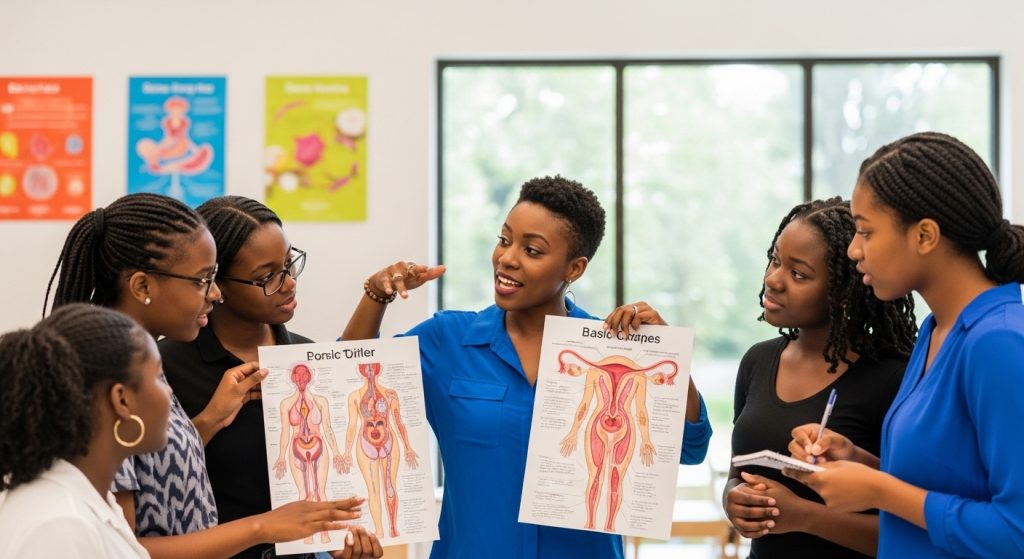
1. ā€œI Spent Years Thinking Discharge Meant I Had An Infectionā€ ā€“ Tamilore*, 26
When I was a teenager, I noticed white stuff in my underwear. I thought something was seriously wrong with me, that I had contracted some disease somehow. But I was too ashamed to ask anyone about it.
I started using panty liners every single day to hide it, convinced that if anyone saw my underwear, theyā€™d know I was dirty or sick. Iā€™d change them multiple times a day, paranoid about the smell even though there was barely any smell at all. I wasted so much money on those liners.
When it finally occurred to me to do a Google search at 21, I almost cried with relief. I found out that vaginal discharge is normal and thatā€™s how the vagina cleans itself. All those years of anxiety and shame because nobody bothered to tell me that my body was functioning exactly as it should.
Why wasnā€™t this stuff taught in biology class? We learned about photosynthesis but not about our own bodies. Iā€™d spent almost a decade thinking I was completely abnormal when I was completely fine. Now Iā€™m very intentional about talking to my younger cousins about these things. I tell them about discharge, about how it changes throughout your cycle, whatā€™s normal and what actually needs a doctorā€™s visit.
2. ā€œMy Auntie Told Me Iā€™d Become Loose If I Used Tamponsā€ ā€“ Eri*, 29
I got my period at 13, and my mother only allowed me to use pads. When I asked about tampons as a teenager, my auntie overheard and pulled me aside. She told me that tampons would ā€œopen me upā€ and make me loose, and that I should save my virginity for my husband. I was confused because I didnā€™t understand how a tampon would affect my virginity. I obviously couldnā€™t express my need for clarity cause she didnā€™t seem open to it at all.
For many more years after that, I only used pads. The discomfort when thereā€™s heat, the fear of leaking and getting stained, and the inability to swim during my period, there were so many restrictions. All because I believed that inserting anything into my vagina would somehow damage it or take my virginity.
When I got to university and had proper sex education, I learned that the hymen is just a thin membrane that can stretch or tear from various activities, including exercise and ā€œtightnessā€ has nothing to do with virginity or how many tampons youā€™ve used. When I later started using tampons and menstrual cups, my period experience changed completely, and I stopped feeling like I was wearing diapers.
3. ā€œI Thought All Vaginas Looked the Same Until I Was 24ā€ ā€“ Tolu*, 27
Iā€™d never really looked at my own vagina properly until I was in my twenties. It felt wrong somehow, like something I shouldnā€™t do. But one day, out of curiosity, I used a mirror, and I was horrified. It felt like my greatest fear had finally come true. My inner labia were longer than my outer labia. They were much darker, too. I immediately thought something was wrong with me.
I started researching ā€œabnormal vaginaā€ and went down a rabbit hole of cosmetic surgery websites talking about labiaplasty. I was sure that I needed surgery to correct my ā€œdeformedā€ vagina. I even started saving money for it.
Then I stumbled on an educational website that showed different types of vulvas, and I realised thereā€™s no such thing as a ā€œnormalā€ looking vagina. Some people have longer inner labia, some have asymmetrical labia, some are darker, some are lighter. The variation is endless, and all of it is normal.
I felt like someone had sold a lie to me my entire life. Watching pornography and the complete lack of real education had made me think all vaginas were supposed to look a certain way. Neat, tucked in and light pink. Thatā€™s not the reality because thatā€™s not how most bodies actually look.
4. ā€œSomeone Told Me Vaginas Get Loose From Too Much Sexā€ ā€“ Nike*, 31
This is probably the most pervasive lie about vaginas. I grew up hearing it everywhere, from friends, movies, and jokes that men made. The idea is that if you have too much sex or change partners a lot, your vagina becomes loose like an old rubber band.
I believed it so deeply that even in my twenties, I was anxious about having sex regularly with my partner. I thought that if we had too much sex, Iā€™d become loose and heā€™d lose interest in me. Sometimes, Iā€™d turn him down, not because I wasnā€™t interested, but because I thought my vagina was supposed to be tight.
When I finally learned that the vagina is a muscle that returns to its normal state after sex, I was shook. Apparently, itā€™s designed to stretch during arousal and sex, and then go back. Thatā€™s how muscles work. You canā€™t wear out your vagina any more than you can wear out your mouth from talking too much.
The amount of anxiety this has caused me is ridiculous. Iā€™d wasted years worrying about something that isnā€™t even physiologically possible. The insane part is how this lie is weaponised against women. Itā€™s used to shame us for having sex, to make us feel like our bodies are depreciated. Nobody tells men their penis gets smaller from too much sex.
These stories are rooted in shame. Shame planted by silence, watered by misinformation, and harvested as anxiety about our own bodies. Weā€™re taught that our natural bodily functions are issues to be fixed or hidden away from the world. What weā€™re learning, instead, is that our bodies are not broken, and we deserve better than lies disguised as wisdom. We need to always remember to talk openly about these topics so that the next generation doesnā€™t inherit the same shame that these women did.